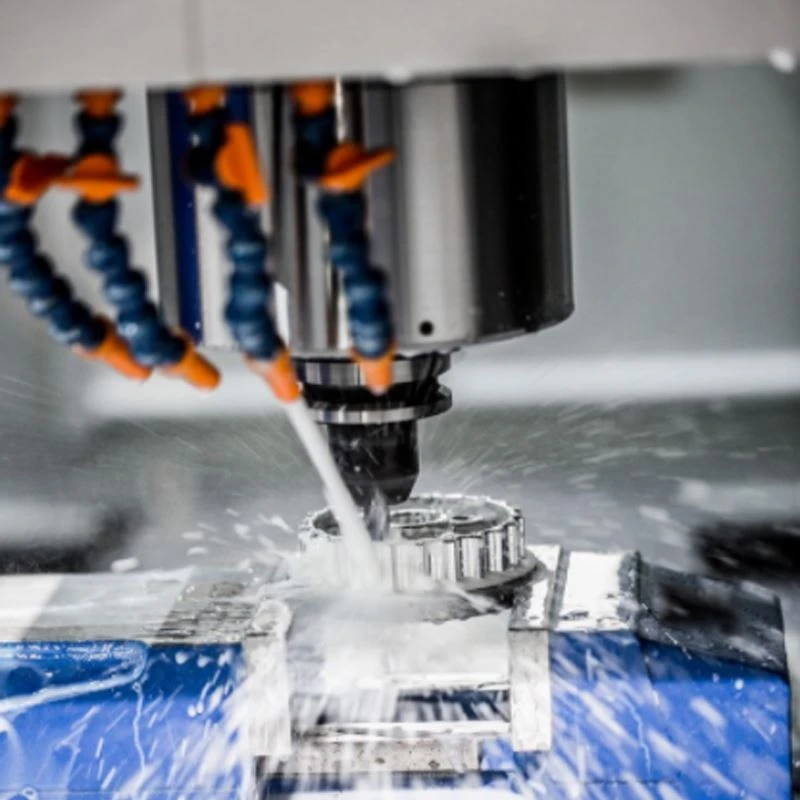
What is the efficient processing method for CNC milling machine? What are the basic issues to consider when processing a CNC milling machine?
Aug 01, 2021
Leave a message
The so-called high-efficiency processing method of CNC milling machine is that it can be completed quickly during processing. Its completion effect is not to be underestimated. Various complex products can be completed. The same is true for CNC milling machine processing. What is the efficient processing method of CNC milling machine?
The machining center is a high-efficiency, high-precision CNC machine tool. The workpiece can be processed in multiple processes in one clamping. At the same time, it also has a tool library and an active tool change function. The rich functions of the machining center determine the messiness of the programming of the machining center.
The machining center can realize the linkage control of three axes or more to ensure that the tool can process the messy surface. In addition to the linear interpolation and circular interpolation functions, the machining center also has a variety of fixed cycle processing, active tool radius compensation, active tool length compensation, processing graphic display, man-machine dialogue, active fault diagnosis, offline programming, etc. .
The biggest difference between the machining center and the CNC milling machine is that the machining center has the ability to actively exchange machining tools. After installing tools for different purposes on the tool magazine, the machining tools on the spindle can be changed through the active tool changer in one clamping. Multiple processing functions.
Generally, the workpieces processed by CNC milling machines have complex shapes, many processes, and many types of tools. Often, the entire process from rough machining, semi-finishing to finishing is completed after one clamping. Therefore, the procedure is more complicated. Consider the following issues when programming.
1. Analyze the drawings carefully to determine a reasonable process route.
2. The size of the tool should be selected, and the actual size measured should be filled into the tool card.
3. Determine a reasonable cutting amount. Mainly the spindle speed, the amount of back-cutting, the feed speed and so on.
4. There should be enough space for automatic tool change to avoid collision with workpiece or fixture. The tool change position is recommended to be set at the machine origin.
5. In order to facilitate the inspection and debugging of the program, the processing content of each step can be arranged in different subroutines, and the main program mainly completes the tool change and the call of the subroutine. This procedure is simple and clear.
6. Check and test run the compiled program, pay attention to whether there is any interference between the tools, fixtures or workpieces. When checking the M, S, T functions, it can be done in the Z-axis locked state.