

What causes welding defects and how to deal with them
Oct 12, 2024
Leave a message
As an essential part of modern manufacturing, the quality of welding directly affects the overall performance and safety of products. However, due to various factors during the welding process, various welding defects often occur. These defects not only reduce the strength, durability, and appearance of the weld joints but may also lead to serious safety incidents. Therefore, understanding the causes of welding defects and their remedies is of great significance for improving welding quality and ensuring product performance.
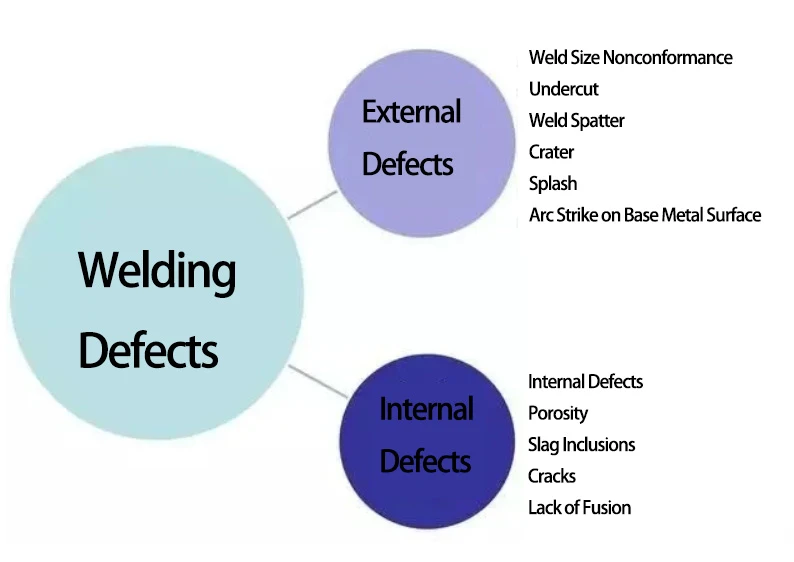
▲ Welding Defects
I Classification of Welding Defects
Welding defects can be categorized into two types based on their position in the weld: external defects and internal defects. External defects, also known as appearance defects, are located on the surface of the weld and can be observed with the naked eye or under low magnification, such as undercutting, weld spatter, concavities, welding deformations, surface porosity, and surface cracks. Internal defects are found inside the weld and can only be detected through destructive testing or specialized non-destructive testing methods, such as lack of fusion, incomplete penetration, internal porosity, slag inclusions, and cracks.
II Causes of Welding Defects
1. External Defects
(1) Undercutting
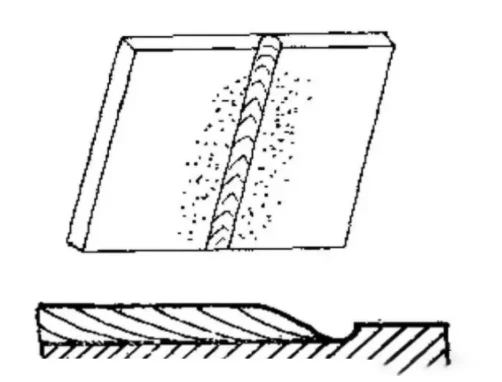
Undercutting refers to depressions or grooves left on the edges of the weld after the base metal is melted by the arc or flame and not filled by weld metal. The main causes include excessive welding current, too long an arc, improper electrode (welding wire) angle or movement, and incorrect welding speed.
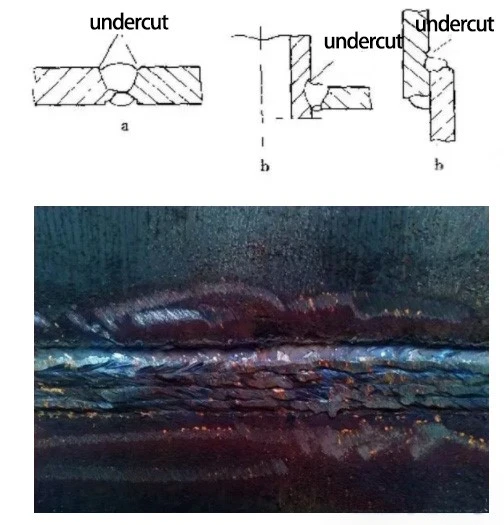
▲ Undercutting
(2) Weld Spatter
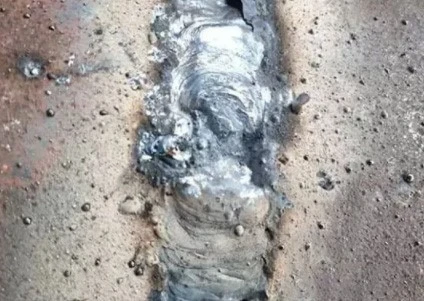
Weld spatter refers to the molten weld metal that flows onto the base metal or root of the weld with insufficient heat during the welding process and forms lumps of metal that do not fuse with the base material after cooling. The causes include poor electrode quality, excessive welding current, too long an arc, slow welding speed, and improper electrode angle and movement.
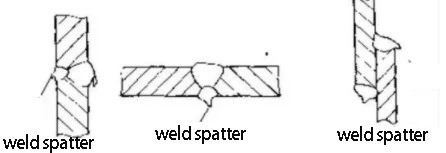
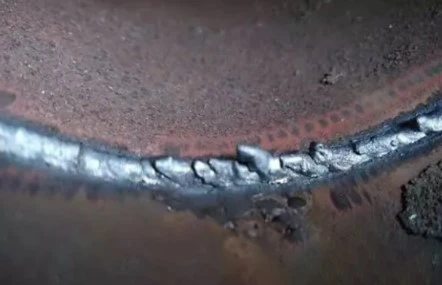
▲ Weld Spatter
(3) Concavities and Welding Deformations
Concavities are usually caused by the failure to hold the electrode (welding wire) for a short period when terminating the arc, resulting in arc craters. Welding deformations may be caused by inadequate preparation, poor fixtures, or inadequate operational skills.
▲ Concavities and Welding Deformations
(4) Surface Porosity
Surface porosity occurs when gas fails to escape entirely from the weld pool during welding, forming holes on the surface of the weld metal. The main causes include non-compliance of welding materials and workpieces with process requirements, low welding current, too fast welding speed, too long an arc, and inadequate protection of the welding area.
2. Internal Defects
(1) Lack of Fusion and Incomplete Penetration
Lack of fusion refers to areas where the weld metal does not fuse with the base metal or between layers of the weld. Incomplete penetration refers to the failure to fully fuse the joint root during welding. These defects are caused by insufficient welding current, too fast welding speed, poor groove design, incorrect electrode angle, and inadequate welding technique.
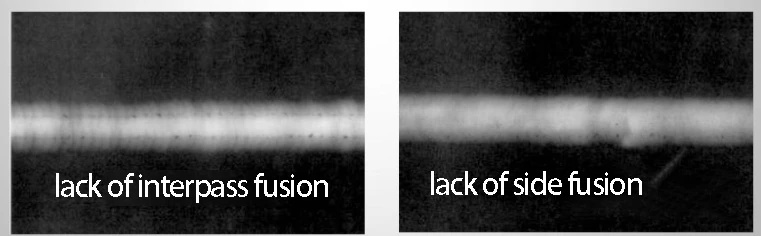
▲ Lack of Fusion and Incomplete Penetration
(2) Slag Inclusions
Slag inclusions refer to the residual slag left in the weld after welding. The causes include low welding current, too fast welding speed, unclean workpiece surfaces, incomplete slag removal in multi-layer welding, and poor electrode quality.
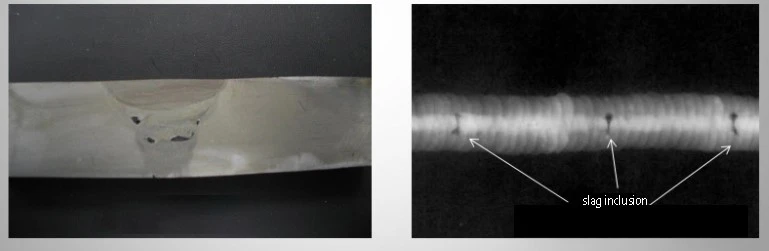
▲ Slag Inclusions
(3) Cracks
Cracks are one of the most dangerous defects in weld joints, and the causes are complex and varied. They include poor welding technique, improper welding specifications, high internal stresses in the weld, high crack sensitivity of the material, and poor quality of filler materials. Additionally, different types of cracks, such as hot cracks, cold cracks, and reheat cracks, are caused by different factors.
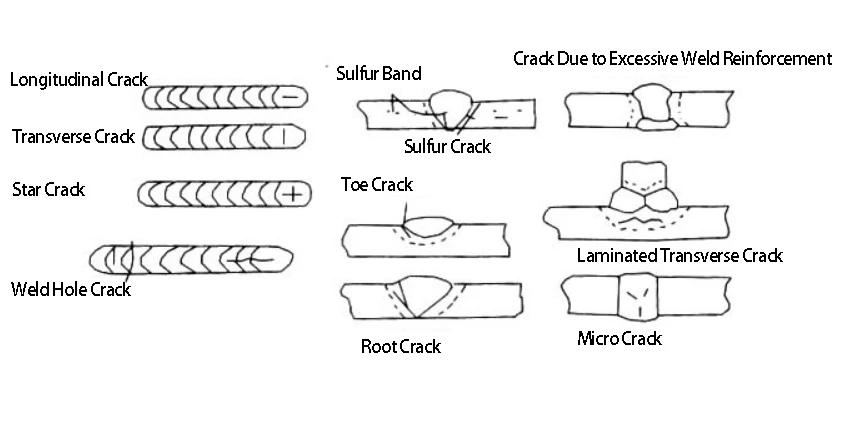
▲ Cracks
III Remedies for Welding Defects
1. External Defect Remedies
(1) Undercutting
Minor and shallow undercutting can be smoothed mechanically to create a smooth transition. Severe and deep undercutting should be repaired by welding. Preventive measures include selecting appropriate welding process parameters, controlling arc length, and mastering the necessary electrode movement techniques.
(2) Weld Spatter
Weld spatter can be removed by mechanical grinding, and the weld should be redone to restore smoothness. Preventive measures include selecting appropriate welding current and electrode angle and maintaining a consistent welding speed.
(3) Concavities and Welding Deformations
Concavities and welding deformations can be corrected through grinding, mechanical straightening, or heat treatment. Preventive measures include proper preparation before welding, using qualified fixtures, and taking steps to eliminate residual deformations.
(4) Surface Porosity
Surface porosity can be removed by grinding and re-welding to fill the voids. Preventive measures include cleaning the welding materials and workpieces, selecting appropriate welding current and speed, and improving the protection of the welding area.
2. Internal Defect Remedies
(1) Lack of Fusion and Incomplete Penetration
Lack of fusion and incomplete penetration defects typically require repair welding or gouging and re-welding. For open structures, direct weld repair can be performed on the incomplete penetration area. For critical weldments where direct repair is not feasible, the weld metal in the defective area should be removed entirely before re-welding.
(2) Slag Inclusions
Slag inclusions need to be removed by gouging out the defective area before re-welding. Preventive measures include improving surface cleaning, selecting appropriate welding current and speed, and ensuring thorough slag removal between weld layers.
(3) Cracks
Crack repairs are more complex and require specific measures based on the type and location of the crack. For hot and reheat cracks, the defective area should be gouged out, and the weld re-done, with improved temperature control and stress relief measures during welding. Cold cracks may require heating, pressure correction, or other methods for repair and prevention.
IV Case Studies of Specific Welding Defects
1. Undercutting Defects
- Phenomenon: Depressions or grooves that appear along the weld toes or root during welding, lower than the base material surface.
- Cause: Excessive welding current, too long an arc, improper electrode (welding wire) angle, too fast welding speed, etc.
- Impact: Weakens weld joint strength, creates stress concentration, and reduces fatigue life.
2. Weld Spatter Defects
- Phenomenon: Metal lumps formed by molten metal flowing outside the weld onto unfused base material.
- Cause: Excessive welding current, too slow welding speed, improper electrode (welding wire) angle, etc.
- Impact: Affects appearance, creates stress concentration points, and hinders effective medium flow in pipelines.
3. Porosity Defects
- Phenomenon: Gas pockets formed inside or on the surface of weld metal when gas fails to escape during welding.
- Cause: Moisture in welding materials, impure shielding gas, too fast welding speed, too long an arc, etc.
- Impact: Reduces weld compactness, decreases the effective working cross-section of the weld, and affects the weld's mechanical properties.
4. Slag Inclusion Defects
- Phenomenon: Non-metallic inclusions in the weld metal.
- Cause: Low welding current, too fast welding speed, unclean groove, incomplete slag removal between layers in multi-layer welding, etc.
- Impact: Affects weld mechanical properties and compactness, potentially leading to weld cracking.
5. Lack of Fusion and Incomplete Penetration Defects
- Phenomenon: Lack of fusion refers to incomplete fusion between the weld metal and base material or between weld layers. Incomplete penetration refers to incomplete fusion at the joint root during welding.
- Cause: Low welding current, too fast welding speed, poor groove design, improper electrode (welding wire) angle, etc.
- Impact: Significantly reduces the mechanical properties of the weld, making it one of the most dangerous defects in welding.
6. Crack Defects
- Phenomenon: New interfaces formed by the destruction of atomic bonding forces in localized areas of the weld joint.
- Cause: Residual stress from welding, poor material quality of the base material or filler material, improper selection of welding process parameters, etc.
- Impact: Sharp crack tips create significant stress concentrations, severely affecting structures subjected to alternating and impact loads, possibly leading to structural failure.
V Conclusion
The causes of welding defects are diverse, and the remedies must be tailored to specific situations. During actual welding processes, strict adherence to welding procedure specifications, enhanced quality control, and timely detection and remediation of welding defects are essential for ensuring weld joint quality and overall product performance. Additionally, with the continuous development and advancement of welding technology, new welding methods and materials are emerging, providing strong support for further improving welding quality and efficiency.