

Liquid Cooling Technology: Boosting Efficiency for High-Density Data Centers
Aug 27, 2024
Leave a message
Ⅰ Advantages of Liquid Cooling Technology
Compared to traditional air-cooling technology, liquid cooling offers advantages such aslow energy consumption, high heat dissipation, low noise, and low TCO, aligning with the trend of high energy consumption and high density in data centers:
- Efficient Heat Dissipation: The cooling capacity of liquid is 1,000 to 3,000 times that of air, making liquid cooling more suitable for high-energy, high-power server applications.
- Energy Savings: Liquid cooling systems can achieve higher energy efficiency ratios, reducing the energy consumption of data centers. Liquid cooling technology, especially immersion cooling, can lower the PUE (Power Usage Effectiveness) of a data center to below 1.2, saving 30-50% of electricity compared to traditional air-cooling methods.
- Increased Equipment Reliability: Liquid cooling technology can reduce equipment failures caused by high temperatures, extend the lifespan of servers, and avoid vibrations and noise caused by fans.
- Space Savings: Liquid cooling allows for a more compact server layout, as it does not require the large airflow spaces needed by air-cooling, thereby saving data center floor space.
- Increased Power Density: Liquid cooling supports higher rack power densities, meeting the demands of high-performance computing and AI applications. Immersion cooling solutions can increase single-rack power to 100kW or even over 200kW.
Mainstream liquid cooling technologies such as cold plate and immersion cooling significantly outperform traditional air cooling in terms of heat dissipation, integration, and energy efficiency.
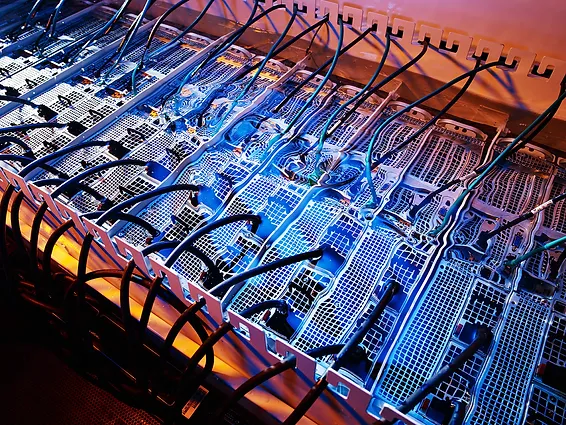
▲ Liquid Cooling
Ⅱ Broader Adoption of Liquid Cooling Technology
As artificial intelligence revolutionizes and the digital economy transforms, data centers are evolving towards higher energy consumption and density, leading to broader adoption of liquid cooling technology. Traditional air cooling can only meet the cooling needs of data centers with 2.7kW per rack, which is insufficient for medium to high-density data centers. Liquid cooling, with its high specific heat capacity and convective heat transfer capability, can meet the cooling needs of data centers with 2.7-30kW per rack, addressing the challenge of ultra-high heat flux density. In the future, liquid cooling technology will see increasingly widespread application in the data center field.
The high computational demands of large AI models are driving the construction of AI infrastructure. As the AIGC industry enters a period of rapid development, the continuous improvement in the performance of large AI models, supported by training on trillions of parameters, leads to substantial computational needs, likely to drive a new wave of AI infrastructure construction. According to OpenAI, the computational requirements for AI model training have doubled every 3.4 months since 2012.
Take the GPT-3 model as an example. According to lambdalabs data, this model has 175 billion parameters, with a total training computation of 3,640 PFlop/s-days (i.e., it would take 3,640 days to complete the computation at 1 PFlop/s). A single training run of the model requires about 355 CPU years and costs $4.6 million (assuming Nvidia Tesla V100 chips are used).

▲ Open AI
Ⅲ The urgent need for high computational power is driving AI infrastructure development
High training computational power needs to be matched with corresponding infrastructure. According to the "2022-2023 China Artificial Intelligence Computing Power Development Assessment Report," global AI spending is expected to grow by 27.9% in 2023, while China's intelligent computing power is expected to reach 427 EFlop/s, a year-on-year increase of 59%.
As the AI industry grows rapidly, the significant gap in computing power is driving the high-speed growth in AI server shipments. In 2023, global shipments of general AI servers/high-end AI servers were 470,000 and 270,000 units, respectively, representing year-on-year growth of 36.6% and 490.5%. It is expected that in 2024, global shipments of general AI servers and high-end AI servers will reach 725,000 and 543,000 units, respectively, representing year-on-year growth of 54.2% and 172.0%.
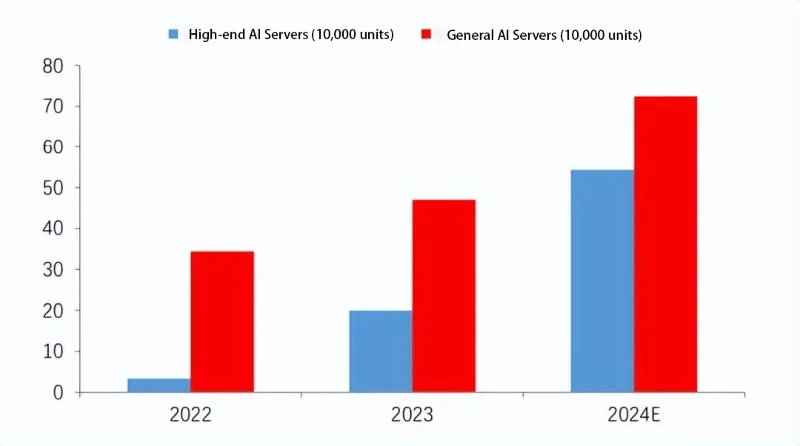
▲ Rapid Growth in AI Server Shipments
According to the 2023 China Liquid-Cooled Data Center Market In-Depth Research Report, China's liquid-cooled data center market is expected to reach 23.63 billion yuan in 2024, a year-on-year increase of 53%. Based on market demand and the development of the industry ecosystem, the market is projected to grow at a compound annual growth rate of 59% over the next five years. By 2027, with the commercial rollout of large AI models and the maturation of the liquid cooling ecosystem, the market size is expected to see significant growth, potentially reaching 102 billion yuan.