

Liquid Cooling Solutions for AI Data Centers – Liquid Cooling Benefits Analysis
Sep 27, 2024
Leave a message
Ⅰ Advantages of Liquid Cooling
To ensure the smooth and efficient operation of today's data centers, many facilities require cooling solutions. With the rise of artificial intelligence and big data, the amount of data that needs to be processed has surged, leading to an increase in heat generated by high-performance processing. Some benefits of switching to liquid cooling solutions include:
1. Switching from Air Conditioning to More Efficient Liquid Cooling Can Reduce Operational Costs by Over 40%
- Transitioning from air cooling to liquid cooling can save energy.
- By reducing the operation of system fans, additional power is conserved.
- Facility investment payback period averages one year, increasing return on investment (ROI).
2. Liquid Cooling Efficiency Significantly Improves Energy Usage Effectiveness (PUE) for High-Performance, High-Power CPUs and GPUs
- Liquid is inherently more efficient at removing heat, up to 1000 times more effective than air cooling.
- As air cooling will no longer meet future cooling demands for CPUs and GPUs, liquid cooling may become a necessity.
- It supports the highest performance and highest density servers, increasing computing power per square foot.
3. Reducing Costs and Environmental Impact
- Liquid cooling reduces power usage and lowers carbon emissions from fossil fuel power plants. Reducing the environmental impact of today's data centers is becoming a corporate responsibility.
- In addition, liquid cooling reduces chip jitter. When a CPU or GPU overheats or approaches its maximum operating temperature, it implements performance reduction measures, known as "thermal throttling," to prevent chip damage. Thermal throttling results in a decrease in system performance, affecting application processing speed.
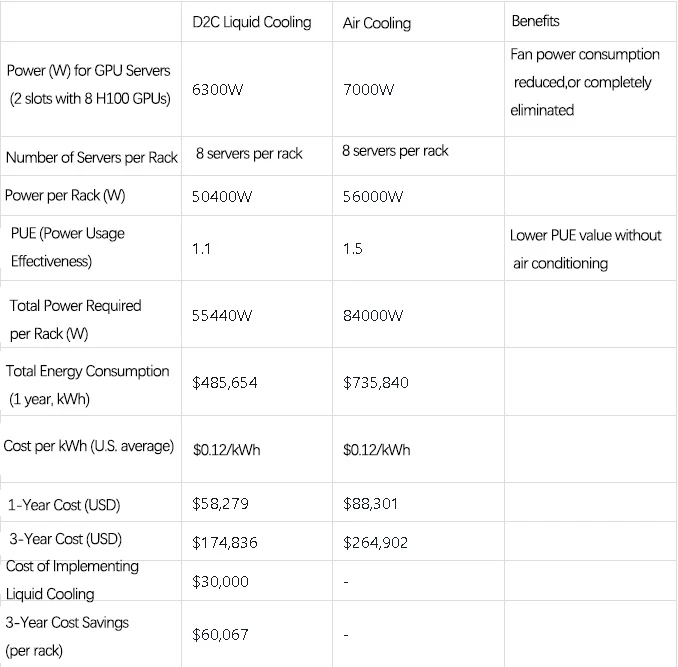
▲ Reducing Costs and Environmental Impact of Liquid Cooling
Specifically, chip throttling can manifest in two ways:
1. Reducing Clock Speed: The CPU or GPU reduces its operating speed, i.e., lowers the clock frequency. As a result, the workload the CPU or GPU can handle per clock cycle is reduced, generating less heat.
2. Disabling Some Cores: In some multi-core CPUs, to reduce heat generation, certain cores may be disabled. Although overall performance decreases, the remaining active cores generate less heat.
These throttling measures are protective actions to prevent CPU overheating. Overheating not only affects performance but may also shorten the device's lifespan and even cause damage. Therefore, ensuring that the CPU and other hardware operate within an appropriate temperature range is crucial.
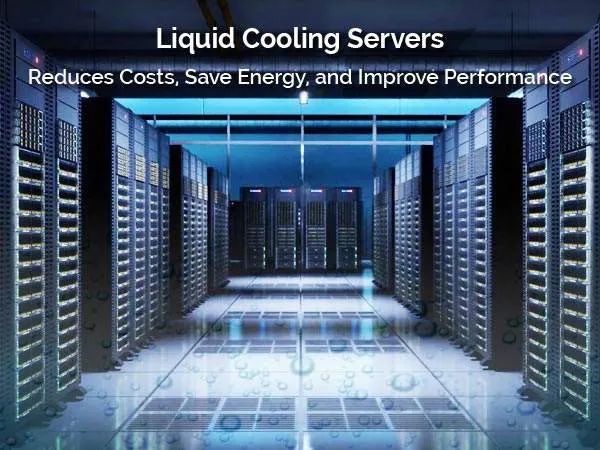
▲ Liquid Cooling Servers
Ⅱ Glossary
Power Usage Effectiveness (PUE)
PUE, or Power Usage Effectiveness, is a standard metric for measuring the energy efficiency of a data center. It is defined as the ratio of total data center energy consumption to the energy consumption of IT equipment. The formula for calculating PUE is:
PUE = Total Data Center Energy Consumption / IT Equipment Energy Consumption
An ideal PUE value is 1.0, meaning all the power entering the data center is used by IT equipment, with no wasted energy. However, in reality, due to factors like cooling systems, lighting, and power inefficiencies, the PUE value is typically higher than 1.0.
Liquid cooling significantly improves the PUE of data centers, mainly in the following aspects:
- More Efficient Cooling: Liquid cooling is more effective than traditional air cooling, able to remove heat more quickly. This means less energy is needed to maintain the same operating temperature for IT equipment.
- Reduced Auxiliary Equipment Energy Consumption: Liquid cooling systems may reduce the need for air conditioning and numerous fans, which typically consume significant energy in air cooling systems. By reducing the energy consumption of these auxiliary devices, the overall PUE of the data center can be significantly improved.
- Supporting Higher Density Computing: Liquid cooling allows for more servers and computing devices to be housed in a smaller space, thereby increasing computing power per square meter. This high-density computing improves IT equipment efficiency without increasing cooling demands.
- Lower Overall Energy Consumption: As liquid cooling is more efficient in heat removal, the overall energy consumption for cooling in the data center is reduced, directly impacting the PUE calculation, bringing it closer to 1.0.
Therefore, for high-performance, high-power CPUs and GPUs, liquid cooling significantly improves data center PUE by increasing cooling efficiency and reducing overall energy consumption, making data center operations more environmentally friendly and cost-effective.