

Introduction and Classification of Liquid Cooling Systems
Sep 11, 2024
Leave a message
In the information age, data center servers are becoming increasingly important as fundamental components of modern computing infrastructure. Equally significant is the heat generated by servers during operation. The growing demands for data processing and storage place severe stress on the computational power and cooling capabilities of servers.
The two mainstream cooling methods-air cooling and liquid cooling-are the main approaches used. Due to the long development history of air cooling, it is a more mature technology and the current mainstream choice. However, with the promotion and commercialization of AI models and cloud computing, and the increasing server power consumption, liquid cooling is becoming the preferred alternative to air cooling.
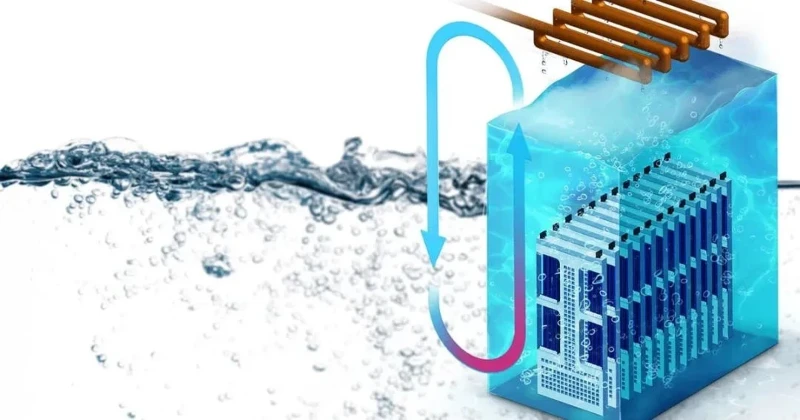
▲ Liquid Cooling System
Server liquid cooling primarily transfers heat generated by internal components of IT equipment in data centers through the flow of liquid, achieving heat dissipation and equipment cooling. Currently, there are three main types of liquid cooling: immersion cooling, cold plate cooling, and spray cooling.
Immersion cooling can be divided into single-phase immersion cooling and phase-change immersion cooling, both of which are direct-contact liquid cooling methods. In this system, servers and other equipment are directly immersed in coolant, which absorbs the heat from the components. Since the heat-generating components are in direct contact with the coolant, cooling density is maximized, providing full coverage. As a result, immersion cooling offers significantly better cooling efficiency than traditional air cooling and standard liquid cooling solutions, providing stable and reliable cooling performance. However, this method requires stringent conditions for server room size and technical handling, with high management and maintenance costs.
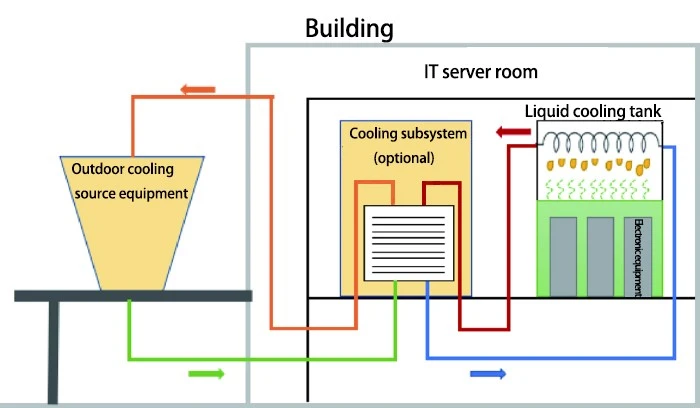
▲ Immersion Cooling
Spray cooling is another direct-contact liquid cooling method, distinct from immersion cooling. In this system, coolant or cooling medium is directly sprayed onto the heat-generating components of servers and other devices. Through the flow and evaporation of the liquid, heat exchange occurs, resulting in cooling. After heat exchange, the sprayed coolant is recycled for re-spraying, making the cost of this method significantly lower than immersion cooling, though the cooling efficiency is somewhat reduced.
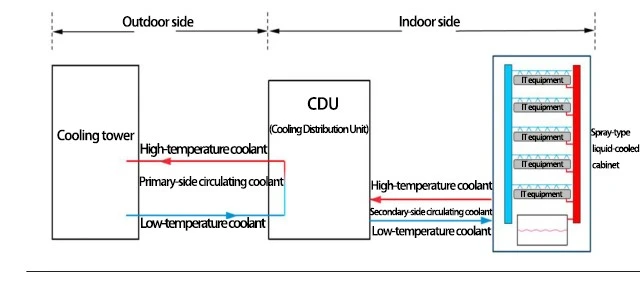
▲ Spray Cooling
In cold plate cooling, heat-generating components mainly come into contact with a cold plate. Coolant flows through the hollow interior of the cold plate, transferring the heat from the components indirectly to the coolant, which then circulates through the system to dissipate the heat. This method is considered an indirect-contact liquid cooling solution. Compared to immersion cooling, cold plate cooling offers more flexibility in choosing the coolant, requires less coolant overall, and is easier to disassemble, install, and maintain. With a high level of technological maturity, it is more suitable for large-scale applications and has a wider range of use.
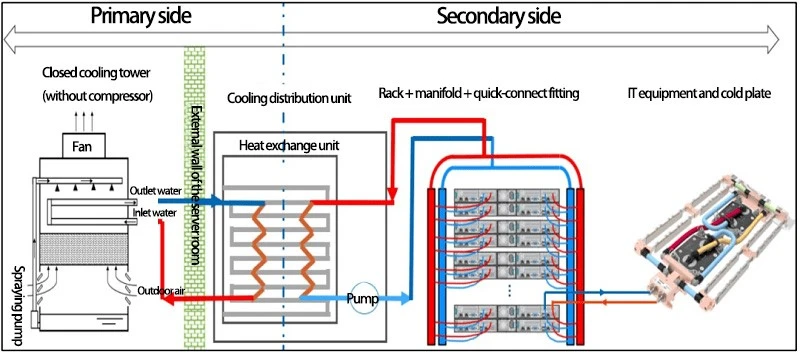
▲ Cold Plate Cooling
In cooling system design, flow resistance and thermal resistance represent the obstacles to heat transfer, with their values directly reflecting the heat transfer capability of different cooling media. Therefore, strict standards must be followed in cooling system design and production, with real-world manufacturing being tested to meet relevant requirements.
For example, the all-in-one liquid cooling systems commonly used in household computers and small base station servers fall under the category of cold plate liquid cooling. We provide water-cooled module thermal efficiency testing machines for such cooling systems. These machines are equipped with four independent test channels and 32 test point interfaces, which can be expanded based on testing needs to meet specific requirements.

▲ All-in-one Liquid Cooling Systems
The equipment is equipped with two water cooling machines, along with a constant temperature water tank control system. Once the water cooling machine is activated and the equipment reaches the set temperature, the water temperature can be adjusted between 20-50°C, with a flow control precision of ±0.05LPM and an inlet temperature control accuracy of ±1°C.
Once started, the equipment can test the product for flow rate, flow resistance, thermal resistance, temperature, and other aspects to collect product data, helping manufacturers clearly understand the cooling performance of their products.