

Principles for Designing Electronic Product Liquid Cooling Systems and Solutions
Oct 11, 2024
Leave a message
I Liquid Cooling Systems and Their Components
With the rapid increase in power density of chips and board-level components, many new products are beginning to use liquid cooling. However, there are also many external doubts and concerns, such as whether risks like leaks, cooling efficiency, and cost should be taken into account.
The definition of a liquid cooling system is shown in Figure 1. The heat generated by PCB components is collected through attached cold plates and then transported to a liquid reservoir by the coolant. Subsequently, the cooled liquid circulates back to the cold plates. Thus, a liquid loop or cooling system is created.
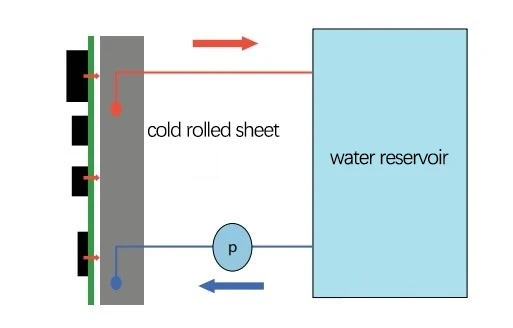
▲ Figure 1. Liquid Cooling System
Figure 2 shows the traditional cooling system used in electronic systems.
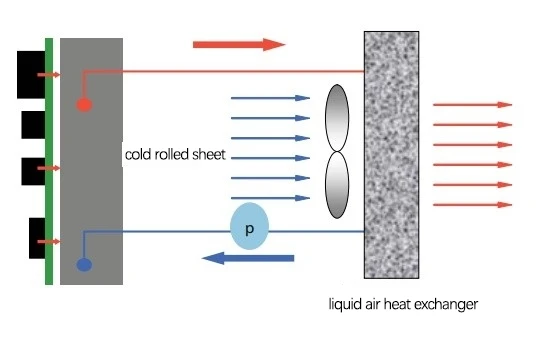
▲ Figure 2. Air-Assisted Liquid Cooling in Electronic Systems
In this structure, the liquid acts as a transfer medium, transferring heat from the heat source to the cold plate, and then to the air via a heat exchanger. The cooling capacity of this system is limited by the design of the heat exchanger or its thermal performance.
When comparing the above systems, significant differences are observed. In a true liquid cooling system (Figure 1), the reservoir is isothermal according to its thermodynamic definition.
This means that its temperature does not change due to heat input. The volume of the reservoir is large enough to keep its average temperature constant, eventually exchanging heat with the atmosphere and the surroundings. This application is currently widely used in data center immersion cooling.
Air-assisted cooling is essentially an air cooling system where the liquid is used as a heat transfer medium between the source and the heat sink.
In either system, liquid cooling has some clear advantages. These benefits include the heat transfer capability of liquids per unit volume and more efficient heat diffusion.
The heat transfer caused by the change in enthalpy in an open system is calculated as shown in Equation 1.
Equation 1:
Q = m (
( -
-  )
)

Where m=ρVA (where ρ is fluid density, V is velocity, A is cross-sectional area), and  is the specific heat at constant pressure.
Assuming that velocity and cross-sectional area are constant, the heat transfer can be calculated for different fluids using  and ρ.
Table 1 shows the values of  , ρ, μ, and k for water and air at 300°K.
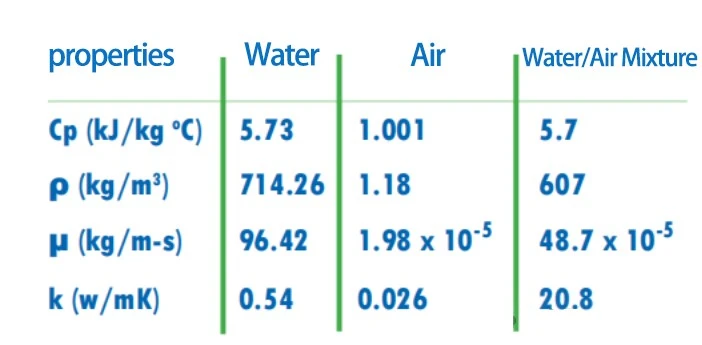
▲ Table 1. Thermodynamic Properties of Typical Coolants
The above clearly indicates the advantage of fluids with high density and heat capacity in transferring thermal loads.
Liquid cooling can also play a crucial role in chip thermal management. Local power consumption at the board and chip levels poses a significant challenge in designing a successful product.
Figure 3 shows an example from a major manufacturer, where the heat flux at a given location on the chip exceeds 2500 W/cm².
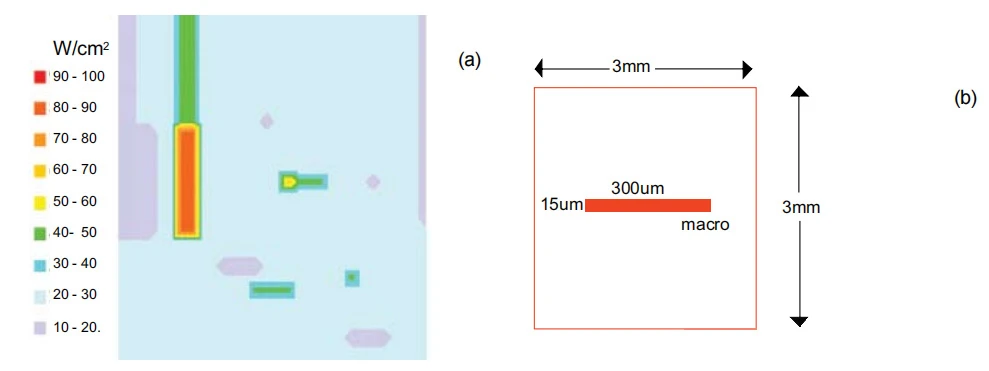
▲ Figure 3. Heat Flux Exceeding 2500 W/cm² in a Microprocessor
Clearly, the localized heat flux can be managed more effectively by spreading the heat over a larger surface area.
Conduction and convective heat transfer are the main methods for this heat dissipation design. High thermal conductivity materials, such as diamond and graphite sheets, will greatly assist in more effectively spreading heat over a larger surface.
By examining the Nusselt number (Nu) and the heat transfer coefficient, one can observe how liquids effectively diffuse heat over a larger surface area. Nu equals hL/k, and the heat transfer coefficient h for a flat plate in laminar flow is given by Equation 2.
Equation 2:
h = k/L [0.332  .
. ]
]

Where
h: heat transfer coefficient
k: fluid thermal conductivity
L: characteristic length
Re: Reynolds number
Pr: Prandtl number
The size of Re is a function of velocity and fluid properties, while Pr depends on the fluid's viscosity and density. Clearly, fluids with a higher k value have larger Re and Pr, resulting in a larger h. Therefore, when considering Newton's law of cooling,
Equation 3:
Q = h (
(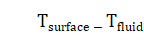 )
)

Under the same flow conditions, changing the fluid type from gas to liquid (i.e., from air to water) results in significantly higher heat transfer.
This reduces the average surface temperature and improves the effectiveness of the device's heat dissipation design. Using liquid cooling, whether pure (immersion) or air-assisted, can facilitate higher heat transfer and better thermal management systems.
However, equipment implementing liquid-assisted cooling systems typically require air cooling for circulation. The focus is often on issues such as fan failure and noise.