
Basic knowledge of industrial robot classification
Apr 01, 2021
Leave a message
Basic knowledge of industrial robot classification
1. Industrial robots are divided into four types according to the motion form of the arm:
1. The rectangular coordinate arm can move along three rectangular coordinates;
2. The cylindrical coordinate arm can be used for lifting, rotating and telescopic actions;
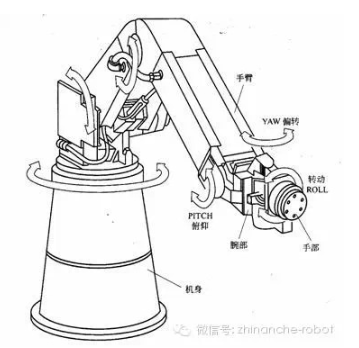
3. The arm of the spherical coordinate type can rotate, pitch and retract;
4. The articulated arm has multiple revolving joints.
2. Industrial robots can be divided into point position type and continuous trajectory type according to the control function of the actuator movement.
1. The point type only controls the accurate positioning of the actuator from one point to another, and is suitable for loading and unloading, spot welding, general handling, loading and unloading of machine tools;
2. The continuous track type can control the actuator to move according to the given track, which is suitable for continuous welding and painting operations.
3. Industrial robots are divided into two types: programming input type and teaching input type according to the program input mode:
1. The programming input type is to transfer the program file that has been compiled on the computer to the robot control cabinet through the RS232 serial port or Ethernet and other communication methods.
2. There are two teaching methods for teaching input type:
One is that the operator uses a manual controller (teaching control box) to transmit the instruction signal to the drive system, so that the actuator can perform the operation according to the required action sequence and motion trajectory;
The other is that the operator directly leads the actuator and performs it again according to the required action sequence and movement trajectory. During the teaching process, the information of the working program is automatically stored in the program memory. When the robot is automatically working, the control system detects the corresponding information from the program memory, and transmits the command signal to the drive mechanism to make the actuator reproduce the teaching Various actions. An industrial robot that teaches input programs is called a teaching reproduction type industrial robot.
Four, intelligent industrial robots
Industrial robots with tactile, force, or simple vision can work in more complex environments; if they have recognition functions or further increase self-adaptation and self-learning functions, they become intelligent industrial robots. It can adapt to the environment according to the "macro instructions" given by people or self-programming, and automatically complete more complex tasks.
【Other knowledge】
1. Operating characteristics of industrial robots
Industrial robot is a kind of multi-functional, multi-degree-of-freedom mechatronics automatic mechanical equipment and system that can complete certain operation tasks in the manufacturing process through repeated programming and automatic control. It can be combined with the manufacturing host or production line to form a single machine or multiple The machine automation system realizes a variety of production operations such as handling, welding, assembling and spraying without unattended participation. Shown in Figure 1 is an industrial robot operating on a production line.
At present, the technology and industry of industrial robots are developing rapidly, and their applications in production are becoming more and more extensive, and they have become important and highly automated equipment in modern manufacturing.
Second, the characteristics of industrial robots
Since the first generation of robots came out in the United States in the early 1960s, the research and application of industrial robots have developed rapidly, but the most significant features of industrial robots are summarized as follows.
1. Programmable. The further development of production automation is flexible automation. Industrial robots can be reprogrammed according to the changing needs of their working environment. Therefore, they can play a very good function in the flexible manufacturing process of small batches and multiple varieties with balanced and high efficiency. It is an important part of the flexible manufacturing system (FMS). .
2. Personification. Industrial robots have parts similar to human walking, waist rotation, big arms, forearms, wrists, and claws in the mechanical structure, and they are controlled by computers. In addition, intelligent industrial robots have many human-like "biological sensors", such as skin-type contact sensors, force sensors, load sensors, vision sensors, acoustic sensors, language functions, and so on. Sensors improve the adaptive ability of industrial robots to the surrounding environment.
3. Versatility. In addition to specially designed dedicated industrial robots, general industrial robots have better versatility when performing different tasks. For example, by replacing the hand end manipulators (claws, tools, etc.) of an industrial robot, different tasks can be performed.
4. Mechatronics. Industrial robot technology involves a wide range of disciplines, but it can be summed up as a combination of mechanics and microelectronics-mechatronics technology. The third-generation intelligent robot not only has various sensors to obtain external environmental information, but also has artificial intelligence such as memory ability, language understanding ability, image recognition ability, reasoning and judgment ability, and these are related to the application of microelectronic technology, especially computer technology. The application is closely related. Therefore, the development of robotics technology will inevitably drive the development of other technologies, and the development and application level of robotics technology can also verify the development and level of a country's science and industrial technology.
Third, the composition of industrial robots
The industrial robot system is composed of three major parts and six subsystems. The three parts are: the mechanical part, the sensing part, and the control part. The six subsystems are: drive system, mechanical structure system, sensory system, robot-environment interaction system, human-machine interaction system, and control system . The six subsystems will be described below.
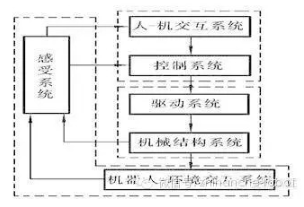
1. Drive system
To make the robot run, it is necessary to place a transmission device for each joint, that is, each degree of freedom of movement. This is the drive system. The driving system can be hydraulic transmission, pneumatic transmission, electric transmission, or a comprehensive system combining them; it can be directly driven or indirectly driven by mechanical transmission mechanisms such as synchronous belts, chains, gear trains, and harmonic gears .
2. Mechanical structure system
The mechanical structure system of an industrial robot is a mechanical part of an industrial robot to complete various movements. The system is composed of bones (rods) and joints (motion pairs) connecting them, with multiple degrees of freedom, mainly including parts such as hands, wrists, arms, and fuselage.
(1) Hand: Also known as end effector or gripper, it is the part where industrial robots directly manipulate the target. Special tools can be installed in the hand, such as welding gun, spray gun, electric drill, electric screw (female) to tighten
(2) Wrist: The wrist is the part that connects the hand and the arm. Its main function is to adjust the posture and orientation of the hand.
(3) Arm: It is used to connect the body and the wrist. It is a component that supports the wrist and hand. It is composed of power joints and connecting rods. It is used to bear the load of the workpiece or tool, change the spatial position of the workpiece or tool, and send them to a predetermined position.
(4) Body: It is the supporting part of the robot, there are two kinds of fixed type and mobile type.