

AI Data Center Liquid Cooling Solutions: Three Optional Solutions
Oct 09, 2024
Leave a message
Data centers today are under immense pressure to handle higher processing demands, driven by AI, machine learning, and big data workloads. As server densities increase, traditional air-cooling solutions are becoming less effective. In response, many organizations are turning to advanced liquid cooling methods to efficiently manage heat generated by CPUs, GPUs, and other critical components. Liquid cooling not only enhances system performance but also reduces energy consumption and operational costs.
In this article, we'll explore three popular liquid cooling solutions for data centers: Direct-to-Chip (DTC), Immersion Cooling, and Rear Door Heat Exchangers (RDHx). Each method presents unique advantages and is tailored to different types of infrastructures.
I. Direct-to-Chip (DTC) Liquid Cooling
Direct-to-Chip (DTC), also known as D2C, is a highly efficient method for cooling individual server components like CPUs and GPUs. In this system, cooling liquid flows directly over the chip via a closed-loop setup, which transfers heat from the chip to the cooling liquid.
How Direct-to-Chip Cooling Works
A cold plate is mounted directly on the chip, using thermal conductive materials to enhance heat transfer. The cooling liquid absorbs heat from the chip and carries it away, returning after being cooled in an external system. A pump, often mounted on the chip, is responsible for maintaining optimal fluid flow through the system.
DTC systems are highly effective in handling concentrated heat from high-performance CPUs or GPUs, making them an ideal choice for data centers with advanced processing needs.
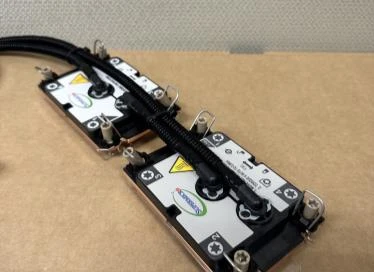
▲ Direct-to-Chip system overview showing pump and cold plate
Configurations for DTC Systems
There are several ways to cool the liquid in a DTC setup. One common configuration is air-cooling the liquid within the server rack using a Cooling Distribution Unit (CDU). The CDU can be installed at various heights in the rack to serve a specific number of servers, minimizing the length of piping. Modern CDUs can remove up to 80 kilowatts of heat, making them suitable for most data center servers.
Another option is to pump the heated liquid to an external system, where it is cooled via liquid-to-liquid heat exchange. This method offloads cooling outside the data center or to specialized external equipment such as cooling towers, which can handle large amounts of heat with minimal impact on server density.

▲ Example of a rack-mounted CDU system
Benefits of DTC Liquid Cooling
DTC cooling is ideal for data centers with high-performance workloads, offering the following advantages:
- Increased efficiency: Liquid cooling is more effective at absorbing heat than air, allowing servers to operate at peak performance.
- Scalability: DTC systems can be scaled to meet growing data center demands by adding more CDUs or external cooling systems.
- Cost reduction: By removing heat more efficiently, DTC systems reduce the need for expensive HVAC systems, saving energy costs in the long term.
II. Immersion Cooling
Immersion cooling is another cutting-edge solution where entire servers are submerged in non-conductive, non-corrosive liquid. This liquid directly contacts the hardware, efficiently absorbing heat as it rises. The hotter liquid is then removed from the system, cooled elsewhere, and re-circulated.
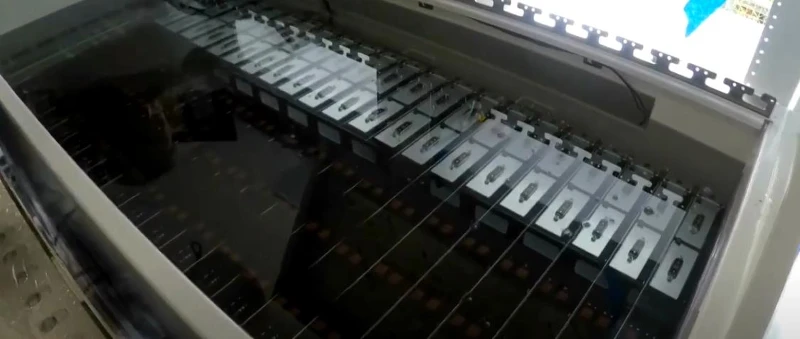
▲ Servers submerged in non-conductive liquid for immersion cooling
How Immersion Cooling Works
The servers are placed in a tank filled with dielectric fluid, which serves as the cooling medium. As the hardware heats up, the fluid absorbs the heat and rises. The heated fluid is then pumped to an external cooling system where it is cooled and returned to the tank.
Immersion cooling offers an extremely efficient way to cool servers with minimal infrastructure requirements. Since it eliminates the need for fans and other air-based cooling components, it reduces both energy consumption and noise levels.
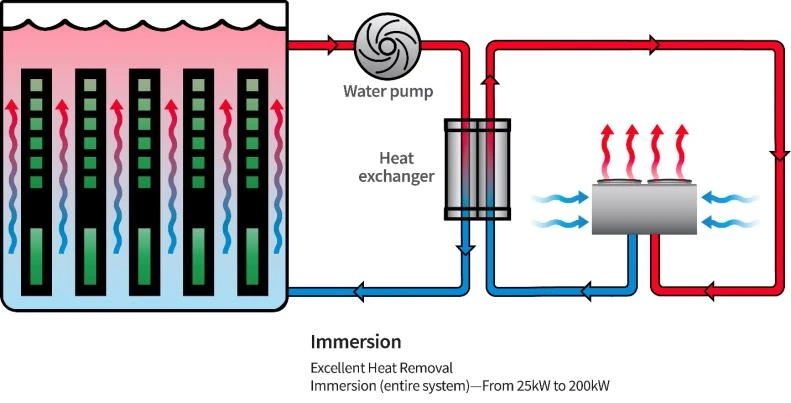
▲ Diagram of immersion cooling with servers submerged in cooling liquid
Advantages of Immersion Cooling
- Enhanced cooling capacity: Immersion cooling can handle high heat loads, making it perfect for high-density server environments.
- Minimal maintenance: With no moving parts inside the server tank, immersion cooling systems are easy to maintain and are less prone to failure.
- Space savings: Since immersion systems often eliminate the need for air cooling components, they allow for more compact server arrangements.
Despite these advantages, immersion cooling requires specialized infrastructure and careful planning to ensure compatibility with server hardware and safety standards.
III. Rear Door Heat Exchanger (RDHx)
For data centers that need to manage heat without drastically modifying their infrastructure, the Rear Door Heat Exchanger (RDHx) is an ideal solution. This system integrates a cooling unit directly into the rear door of server racks, allowing it to cool the hot air that servers exhaust.
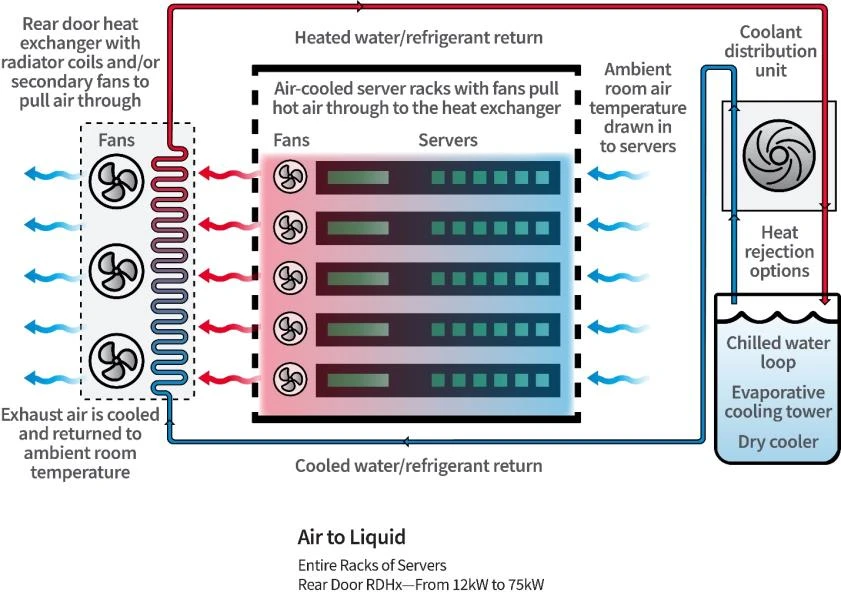
▲ Rear door heat exchanger mounted on a server rack
How RDHx Systems Work
As hot air exits the back of the server, it passes through the RDHx, which uses fans and cooling media to absorb the heat. The cooled air is then recirculated into the data center. Similar to other liquid cooling methods, RDHx systems require the hot liquid medium to be cooled externally before being reintroduced into the cycle.
Benefits of Rear Door Heat Exchangers
- Cost-effective: RDHx systems can be installed on existing racks, making them a cost-efficient upgrade for data centers that do not want to overhaul their cooling infrastructure.
- Energy-efficient: By removing heat at the source, RDHx systems reduce the load on traditional cooling systems, such as Computer Room Air Conditioners (CRACs).
- Space optimization: Unlike CDU systems, which may take up valuable rack space, RDHx systems are mounted externally, preserving server density.
Comparison of Cooling Solutions
| Cooling Method | Key Features | Advantages | Ideal Use Case |
|---|---|---|---|
| Direct-to-Chip | Liquid flows over CPUs/GPUs in closed loop | High efficiency, scalable, reduces energy | High-performance workloads |
| Immersion Cooling | Entire servers submerged in dielectric fluid | Handles high heat loads, minimal maintenance | High-density server environments |
| RDHx | Mounted on server racks to cool exhaust air | Cost-effective, energy-efficient, saves space | Data centers with limited infrastructure |
Summary: Choosing the Right Liquid Cooling Solution
The optimal liquid cooling solution depends on your data center's infrastructure, server density, and performance requirements. Direct-to-Chip cooling is ideal for data centers with concentrated heat loads, while immersion cooling offers exceptional cooling performance for high-density environments. Rear Door Heat Exchangers provide a cost-effective, scalable solution for data centers looking to improve cooling efficiency without major infrastructure changes.
Ultimately, implementing the right liquid cooling solution can lead to significant operational savings and ensure your data center remains efficient, reliable, and ready to meet the growing demands of AI and big data applications.
Frequently Asked Questions (FAQs)
What is Direct-to-Chip (DTC) cooling?
DTC cooling involves running liquid directly over server chips like CPUs or GPUs in a closed-loop system, efficiently removing heat.
Is immersion cooling safe for servers?
Yes, immersion cooling uses non-conductive liquids to ensure the safety of electronic components, allowing servers to be submerged directly in the liquid.
What is the difference between RDHx and traditional air cooling?
RDHx systems cool the hot air exiting servers directly, whereas traditional air cooling relies on air circulation and HVAC systems for cooling.
Can liquid cooling save on data center energy costs?
Yes, liquid cooling is generally more efficient than air cooling, which can lead to significant energy savings over time.
Do all servers support immersion cooling?
Not all servers are designed for immersion cooling, so it's important to consult with hardware manufacturers for compatibility before implementation.
What is the lifespan of a liquid cooling system?
Liquid cooling systems, when properly maintained, can last many years, often outliving traditional air-cooling methods due to reduced wear on components.