

What are the influencing factors involved in the planning and design of a successful pharmaceutical factory?(2)
Apr 09, 2021
Leave a message
Biopharmaceutical engineering design is a comprehensive discipline that uses pharmacy theory, engineering design and actual biopharmaceutical companies to complete the planning and design of preparations, and realize the combination of a series of theory and practice such as mass production of drugs and quality control. The object of biopharmaceutical engineering design research is to study how to organize, plan and realize the large-scale industrial production of biopharmaceuticals in pharmaceutical projects, and finally build a biopharmaceutical production enterprise with high quality, high technology content, high labor productivity, environmental protection standards, and safe operation. .
Biopharmaceutical engineering design is a comprehensive discipline that uses pharmacy theory, engineering design and actual biopharmaceutical companies to complete the planning and design of preparations, and realize the combination of a series of theory and practice such as mass production of drugs and quality control. The object of biopharmaceutical engineering design research is to study how to organize, plan and realize the large-scale industrial production of biopharmaceuticals in pharmaceutical projects, and finally build a biopharmaceutical production enterprise with high quality, high technology content, high labor productivity, environmental protection standards, and safe operation. .
After the new biological drugs are successfully developed in the laboratory, how to transform them into drugs for clinical application, how to transform the technology into productivity, and how to transform the results into economic benefits are the issues of how to carry out industrial-scale production. The research content of biopharmaceutical engineering design can make the above assumptions become reality, that is, complete the transformation from laboratory products to industrialized products, and transform the research results of new drugs into plans for the construction of pharmaceutical enterprises and put them into practice.
Using the theory of pharmaceutical engineering design, the laboratory’s biopharmaceutical production process is scaled up step by step from the pilot test to the corresponding conditions for large-scale production, and the most reasonable and economical production process is designed in the selection, and the product is selected according to the grade. Appropriate equipment, design parameters of all levels and various types, and at the same time select the site, build workshops, arrange workshops, equip with various levels of production equipment and facilities, quality control equipment, inspection and laboratory equipment, automatic instrument control equipment, and others The public engineering equipment finally enabled the pharmaceutical company to successfully put into production according to the predetermined design expectations. This process is the whole process of biopharmaceutical engineering design. The engineering design of a biopharmaceutical plant generally includes the following aspects:
Factory general plan design: After the site is determined, it involves the division and layout of the plant area, the composition and layout of the workshop and other facilities, the layout of the transportation system, the layout of the plant pipeline (materials, water, electricity, steam, gas, etc.), Greening layout, long-term development layout planning, etc.;
Process design: Involving process flow, equipment purchase, production capacity estimation, labor quota and production shift system, workshop water, electricity, steam (gas), cold public engineering quantity estimation, pipeline calculation and design, design manual compilation, summary The preparation of the budget, in addition to other professional requirements;
Other designs include: heating, ventilation, heating, power supply (lighting and power), steam (gas), weak current, fire alarm, automatic control instrumentation, engineering economy, general map transportation, pipelines, etc.
In addition, the design strategy of modern biopharmaceutical plant facilities should also consider the design strategy of online cleaning CIP and online sterilization SIP and the design strategy of biologics plant facilities. The biologics plant design strategy can be used in the prevention and control of pollution and cross-contamination in the aseptic production process of biopharmaceuticals, the selection and confirmation of process equipment based on risk assessment, and the use and maintenance of injection water/purified water/pure steam systems.
Process design of biopharmaceutical plant
The technological process of biopharmaceutical production is becoming more and more complex, and the raw materials used are various in variety and specifications, which can easily cause human error and cross-contamination of products. Therefore, the process layout of the clean workshop is extremely important. In order to prevent the mixing and cross-contamination between the flow of people and logistics, four basic requirements are put forward for the design specification:
Set up the import and export channels for personnel and materials respectively;
Personnel and materials entering the clean production area should have their own purification rooms and facilities;
Only necessary process equipment and facilities should be installed in the production operation area;
The elevators that transport personnel and materials should be separated. The elevator should not be located in a clean area;
In addition, there are also response regulations for the layout of clean rooms and the layout and cleanliness levels of production auxiliary rooms.
The purification of personnel is a key part of whether the clean workshops of the pharmaceutical industry can meet GMP requirements. Among the many sources of pollution, people are the biggest source of pollution. If people enter the clean area, if the purification is not performed or the purification effect is not good, a large number of particles and microorganisms will be brought in, which will seriously affect the air cleanliness of the clean area.
As the equipment itself and its installation quality are related to the cleanliness effect of the clean room, the "Design Code" requires that the clean room should be equipped with dust-proof and anti-microbial pollution equipment and facilities, and the structure, components, internal and external surfaces, transmission components, and filtration of the equipment should be adopted. The materials, performance, accessories and installation of the device, etc. have all been clearly stipulated.
When the equipment is installed in rooms or walls with different cleanliness levels, in addition to fixing, a reliable sealed partition device should be used to ensure that the requirements for different levels of cleanliness are met. When conveying materials between areas with different air cleanliness, if a conveyor belt is used, in order to prevent cross-contamination, the conveyor belt should not pass through the partition, and should be transported in sections on both sides of the partition. In the non-sterilizable product production area, the transfer of materials between areas with different air cleanliness must be transferred in sections, unless the transfer device adopts a continuous disinfection method.
Things to consider when designing a biopharmaceutical plant include product requirements and risk assessment; key process steps; product protection and avoidance of contamination; hazards/risks and personnel protection; environmental pollution control methods; sterile product process categories; open production or closed Production; overall design of plant facilities; production area and HVAC system.
For architecture and layout, design standards should be considered; layout and human logistics direction; room function; building surface decoration and materials; conversion area; support area.
For the heating ventilation and air conditioning system (HVAC), the cost should be considered; the source of particulate pollution; key environmental parameters; risk assessment; facility layout and HVAC system requirements; process and HVAC system coordination; monitoring system; HVAC system Confirmation; cleaning and maintenance of the HVAC system.
For electrical equipment, power distribution; lighting; hazardous environments; electrical pipelines; door interlocks; sockets and other equipment should be considered.
For control and instrumentation, the critical process environment; production process parameters; instrument list; electrical installation requirements should be considered.
In the use of isolator technology, attention should be paid to system definition; equipment design; decontamination procedures (isolator); high-level disinfection (RABS and other barrier designs); environmental monitoring; leak detection (isolator); air system detection; maintenance.
Build a biopharmaceutical production workshop that meets GMP requirements
How to build a biopharmaceutical production workshop that meets the requirements of GMP is a very complicated issue, which should be considered from the following aspects:
Plant design ideas and matters needing attention
In terms of the process design of the plant, the process layout needs to be determined according to the process flow of the product. The process layout should be reasonably connected according to the sequence of the processes to avoid crossing and roundabouts and mixing of people and materials. Personnel and materials should have their own entrances and exits, and the flow of people should be separated as far as possible. The clean workshop should be reasonably arranged according to the cleanliness level, and the processes with high cleanliness level should be located in the center, and corresponding auxiliary measures should be set up, including measures such as cleaning and changing clothes.
In terms of the architectural design of the plant, first consider the type of plant design, that is, a single-story plant or a multi-story plant. Generally speaking, there are more single-storey large-span factory buildings. The advantage is that the process layout of single-storey factory buildings is easier and more reasonable than multi-storey factory buildings; it is more flexible, which is convenient for the update of production varieties and the renovation of the workshop when the process changes; it is convenient for equipment installation and public pipelines installation.
For the requirements of clean room cleanliness level, my country's currently implemented "Clean Plant Design Code" GB73-84, in principle, adopts the air cleanliness level of industrial cleanrooms commonly used in most countries in the world, and the cleanliness level is divided into three levels. To achieve the above 3 levels, the issues that should be paid attention to in the design are:
Airflow organization, generally vertical laminar flow and horizontal laminar flow are used for class 100, turbulent flow is used for class 10,000 and 100,000 (generally the top air supply is provided, and the lower wall is provided with a return air outlet);
Differential pressure, the area with high cleanliness level has a positive pressure to the adjacent areas with low cleanliness level;
The air supply volume is an important factor for the clean room to meet the requirements of the level. A certain coefficient should be left in the design according to the actual situation;
Fresh air volume, fresh air volume generally accounts for 70% of the air supply volume.
In addition, there are some other issues worth noting in the design of clean workshops:
The clean area and the auxiliary area shall be divided on the plan, and the personnel must pass through the auxiliary area first to enter the clean area. Auxiliary areas include dressing rooms, buffer rooms, and the direction of people flow should be from low-cleanliness area to high-cleanliness area;
In order to save energy, the clean area should not be too large when it meets the production requirements, and the height should be reduced as much as possible, generally around 2.5m;
The joints between clean rooms of different cleanliness levels should be equipped with dust-proof facilities, such as air locks, transfer windows, etc.;
The partition windows between the clean area and the non-clean area are double-sealed windows, and the doors should be tight.
Problems in the process of plant construction
To make the newly-built plant meet GMP requirements, quality control in the process of plant construction is very important. In civil construction, the structure of the plant is required to be managed and controlled by civil engineering and construction technicians. The author will introduce the issues related to the GMP requirements of the workshop here.
The walls are required to be flat and smooth, without leaving dust and easy to clean, so the walls are generally painted with high-quality waterproof paint. Color steel plate materials can be pasted on the walls of the workshop with high cleanliness level, and the junction between the inner wall and the ceiling should be made into a round corner.
The partition material is generally made of aluminum alloy and polystyrene color steel plate. In particular, color steel plates are used in clean-level workshops. The advantages of this material are light weight, bright and smooth, easy to clean, easy to construct, and easy to rebuild the workshop when the production process is changed.
The ground material requires high strength, wear resistance, smooth and flat, and easy to clean. Generally, epoxy resin ground is used. There is no floor drain on the floor of the workshop with high cleanliness.
Windows generally use steel windows and aluminum alloy windows. The junction between the window and the wall should be made of oblique angles. The windows with high cleanliness should be made of fixed windows. The window glass and the wall should be made of the same plane to prevent dust accumulation along the window. Easy to clean.
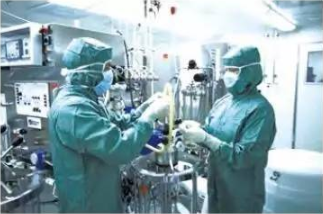
The important role of biopharmaceutical equipment
First of all, pay attention to the selection of equipment:
The equipment should be suitable for the process requirements of the production variety, and its capacity should be suitable for the mass production capacity;
The equipment structure should be simple, easy to operate, easy to disassemble, clean, sterilize and repair;
The transmission part of the equipment should be well sealed to prevent drug contamination;
Production equipment should be equipped with effective dust catching devices;
The applicable scope and accuracy of various measurement and detection control instruments of the equipment should meet the production requirements and meet the measurement standards stipulated by the state.
Secondly, in the material of the equipment, it should be ensured that the contact surface with the processed items should be smooth and flat, easy to clean and disinfect, high chemical resistance, and not react with the processed items to change its composition and content.
After that, the layout of the equipment should be:
The equipment should be reasonably arranged according to the technological process, so that the processed materials flow in the same direction, avoiding repeated round trips.
The equipment should have enough operating space and occupy a reasonable area. Some equipment can be installed in a mobile or semi-fixed way to facilitate cleaning and maintenance. The equipment in the clean area should be installed in separate rooms in order to prevent mutual contamination. Equipment that spans areas with different cleanliness levels should take measures to keep areas with high levels of cleanliness free from contamination.
Fixed installation pipelines should be painted in different colors in accordance with "Pharmaceutical Industry Equipment and Pipeline Coloring Regulations" and should have flow direction signs. Clean-level workshops and pipelines should be installed in technical compartments and technical shafts to avoid and reduce exposure.
Finally, in addition to its selection, installation, and use that should be compatible with the drug production requirements, biopharmaceutical production equipment should be verified after installation, and a verification cycle should be established and verified regularly.