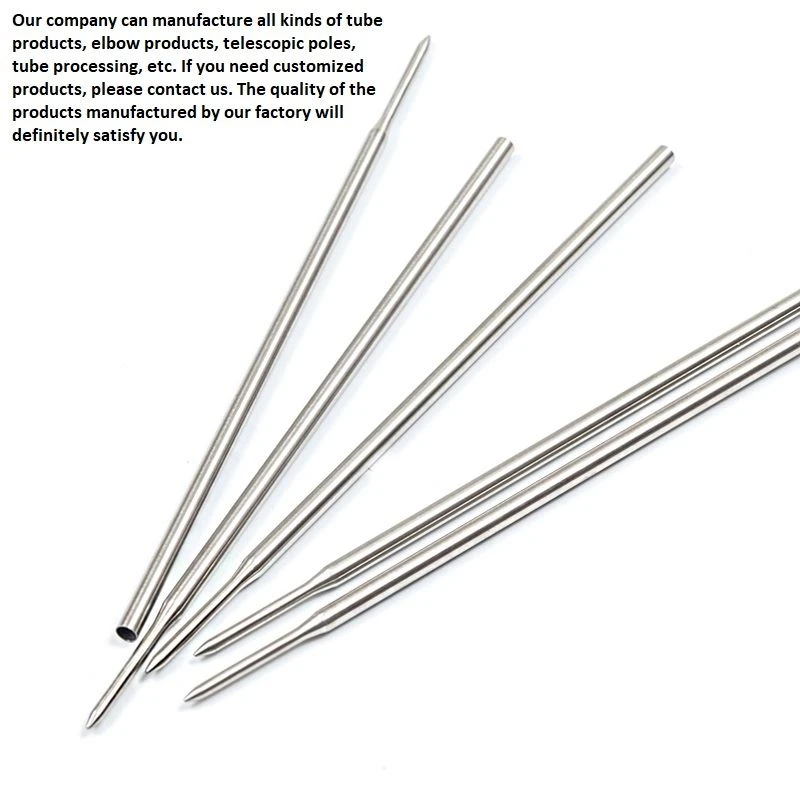
The production and processing methods and problems of stainless steel capillary parts
Aug 28, 2021
Leave a message
Stainless steel capillary fittings are made of bent pipe production, processing and deformation. In its production and processing, there have always been some difficult levels of production and processing, so it is necessary to pay the most attention to how to adjust, water cooling, and moisturize the CNC blade during production and processing. Now let's introduce in detail the various methods, difficulties and relative common problems of the deformation of stainless steel capillary pieces.
Production and processing methods of stainless steel capillary parts:
1. Pipes with bosses and rounded edges. The first one refers to the stainless steel capillary beam end protruding to the inside or both sides, and the latter refers to the pipe with protrusions or grooves in the center of the stainless steel capillary.
2. The stainless steel elbow changes the wall thickness of the stainless steel capillary tube, which changes the wall thickness along the length of the pipe.
3. Stainless steel elbows are used to bend pipes. Generally, it is more commonly used to change the stainless steel plate to different angled elbows, such as elbows, elbows, etc.
4. The stainless steel elbow becomes straight pipe, that is, the pipe end or a certain part of the pipe becomes smaller.
5. Stainless steel capillary fittings with coiling and machine type, to increase the total compressive strength of the stainless steel capillary end to the two sides or the inner side of the pipe, or to seal the pipe beam end.
6. Production and processing of the cross section of stainless steel capillary tubes, turning the circular cross section into a square, ellipse, and irregular pattern. Difficulties in the production and processing of stainless steel capillary parts
There are many difficulties in the production and processing of stainless steel capillary parts. One is that during production and processing, the friction between the steel parts and the CNC blade will cause high-calorie food, which is very easy to damage the CNC blade. Therefore, the requirements for tool materials are stricter, and they must be resistant to wear and heat. And also consider the sharp tooth surface. Another problem is that the production and processing speed ratio is relatively slow, because the bearing reaction force will be large during drilling, which may result in low productivity. In addition, because of the high calorific value, it is necessary to choose a good water cooling oil, generally isopropyl titanate sulfur is used, which will have good practical results. But the left and right are considered good, the more difficult is actually drilling deep holes and tapping. Therefore, in the production and processing of stainless steel capillary parts, construction workers must have a solid experience and skills.
Common problems in the production and processing of stainless steel capillary tubes:
The first thing to pay attention to is the production and processing characteristics of the stainless steel plate. The stainless steel plate has large plastic deformation and high ductility during drilling. It consumes a large amount of kinetic energy during drilling. The drilling temperature is high. The heat transfer rate of the stainless steel plate is low. The heat pipe does not dissipate heat. It is difficult to solve the problem that the temperature of the CNC blade will rise, the stainless steel plate has strong adhesion and weldability, and it is very easy to transform into a buildup during drilling. The cold work hardening tendency of the stainless steel plate is strong. The drilling surface is very easy to transform into a softened layer, and the stainless steel plate is not easy Chip breaking and blockage during drilling may cause damage to the smoothness of the stainless steel processing surface. The second is the stainless steel CNC tool, the rake angle is not easy to be very large, usually 12-30 °, grinding the crescent-shaped chip guide on the front side can improve the drilling standard, and the back angle is for the carbide turning tool. The relief angle must be 6-10°. For high-speed steel turning tools, the relief angle must be 8-12°. Zero, it should be lower than zero during fine turning, the sharp knife half-longitude, generally 0.2-0.8mm. The third is that we must pay attention to water cooling and lubrication when drilling stainless steel plates, and use a lubricant with good water cooling and bonding properties, which can reasonably improve efficiency.
Please contact us if you need: zhang@pride-cnc.com.