

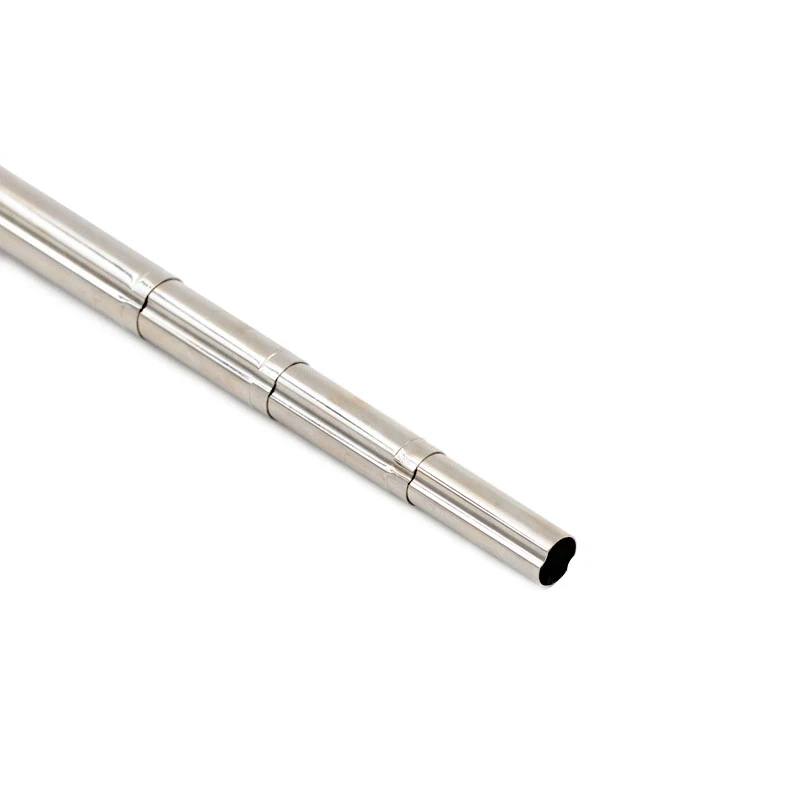
Temperature Sensor 316 Stainless Steel Sensor Tube With F... Service Stainless Steel Shrinke Tip Tube Ending
Aug 11, 2022
Leave a message
Mechanical parts are elastically deformed when loaded, and stiffness is the ability of a material mechanical part or structure to resist deformation under external force. The stiffness of a material is measured by the value of the external force required to produce unit deformation. The stiffness of mechanical parts depends on Its elastic modulus E or shear modulus G geometry and size, as well as the action form of external force, etc. Analysis of the stiffness of mechanical parts is an important work in mechanical design. For some parts that need to strictly limit deformation (such as wings Machine tool spindle, etc.), the deformation must be controlled by stiffness analysis. We also need to control the stiffness of the part to prevent vibration or instability. In addition, such as springs, must be controlled by controlling its stiffness to a reasonable value to ensure its specific function. Stiffness The criterion is that the elastic deformation of the part under load is not greater than the allowable elastic deformation. The expression of the stiffness criterion is: y is the amount of elastic deformation, such as the longitudinal elongation (shortening) of the deflection [y] is the corresponding allowable amount of elastic deformation. The amount of elastic deformation of the part can be obtained by theoretical calculation or experiment, and the allowable amount of deformation depends on the use of the part, Determined according to theoretical analysis or experience. Due to friction and other reasons, the temperature of mechanical parts and lubricants will generally increase when the machine is running. Excessive working temperature will lead to a decrease in the lubrication effect, and at the same time, it will also cause the thermal deformation hardness and strength of the parts to decrease, or even damage. For example, at high temperatures, metal mechanical parts may be glued and stuck; non-metallic mechanical parts such as plastics may soften or even melt, and in some cases, thermal stress may also be caused. The heat resistance criterion is generally to control the working temperature of mechanical parts Do not exceed the allowable value to ensure that the components work properly, the expression is.
Contact Us:
Email: zhang@pride-cnc.com
Tel: +86-755-23699351
Mob: +8618666663894