

Research on mechanical reinforcement technology of CQFP packaged devices for aerospace
Mar 17, 2021
Leave a message
Research on mechanical reinforcement technology of CQFP packaged devices for aerospace
Abstract: Using different sealing methods, the anti-vibration effect of CQFP packaged devices for aerospace under severe mechanical conditions is verified, and the thermal cycle test shows the effect of different adhesives on solder joints due to the difference in thermal expansion coefficient. Mechanical tests show that the use of potting S113 glue + four-corner spot sealing epoxy 6101 and underfill and four-corner spot sealing use epoxy 55/9 + pin brushing S113 glue solid sealing method, both of which can meet the requirements of mechanical reinforcement , There is no damage to the device and solder joints after the mechanical test. However, the temperature cycle test showed that the former caused greater damage to the solder joints of the CQFP device due to greater thermal mismatch, while the latter did not cause significant damage to the solder joints. Therefore, the reinforcement of CQFP devices should be treated differently according to different operating conditions of the product.
Keywords: CQFP packaged device; epoxy glue; mechanics; thermal cycle; microstructure
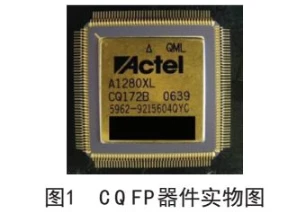
CQFP devices have many advantages such as high density, high reliability and excellent electrical performance and have been widely used in large-scale integrated circuits. The commonly used pin numbers are 256, 240, 228, 208 and 172, etc., and the pin spacing is average It is 0.500 mm or 0.635 mm, and the mass is generally 8-20 g. The actual device is shown in Figure 1. The solder joints of CQFP devices play a dual role of electrical connection and mechanical connection in practical applications. Once the solder joints fail, the function of the device will not be realized.
In addition to the quality of the solder joints, the factors that affect the reliability of the solder joints of CQFP devices are also closely related to the reinforcement method of the device and the maximum mechanical characteristics that the device can withstand. Research on the domestic reinforcement methods for CQFP devices are also different, mainly including the following [1-5]: 1) Fill D04 or GD414 silicone rubber at the bottom of the device; 2) Seal GD414 silicone rubber at the four corners of the device; 3) The four corners of the device are sealed with E-44 epoxy glue; 4) the whole is potted with QD231 block silicone rubber; 5) the four corners are sealed with GD414, the QD231 block silicone rubber is potted; 6) the four corners are sealed with D04, and the QD231 block silicon is potted Rubber; 7) Four-corner spot sealing epoxy 6101, potting polyurethane S113 glue, etc. The above reinforcement methods can meet the product performance under certain conditions, but with the continuous improvement of the reliability requirements of aerospace electronic products, especially the large-scale vibration and severe temperature change environment experienced by deep space probes, as well as high integration The application of CQFP packaged SIP modules (with a mass of more than 20 g) in aerospace electronics is gradually increasing. If CQFP packaged devices are improperly reinforced, the problem of solder joint cracking is very likely to occur. Therefore, it is necessary to further verify and improve the reinforcement effect of the existing CQFP packaged devices to meet the demand for electronic products in the complex and harsh space environment.
1 Test materials and process
In order to compare the reinforcement effects of different adhesives, this paper takes CQFP228 as the research object, and uses epoxy 6101, epoxy 55/9 and polyurethane S113 as reinforcement materials. Among them, epoxy 55/9 is added with a proper amount of talcum powder and solder is used. Sn63Pb37 solder wire, 2 printed boards, 4 chips for each soldering. The specific test plan is shown in Table 1.