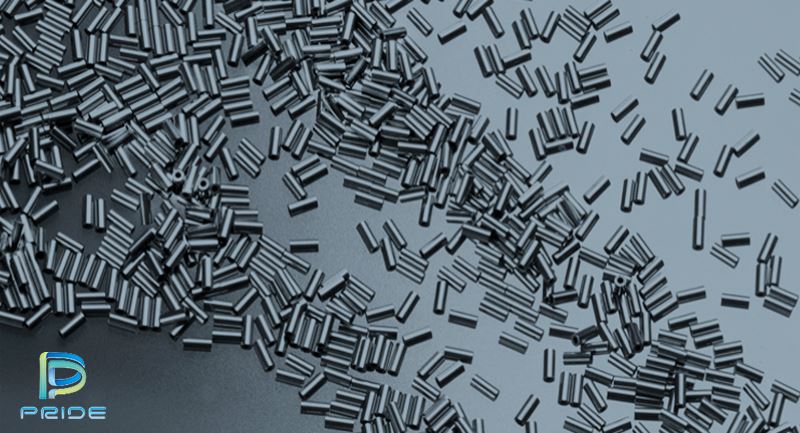
Advantages and disadvantages of metal shearing process
Dec 06, 2021
Leave a message
Is shear suitable for cutting simple shapes?
For simple cutting of metal parts, the metal shearing process is a very attractive option. It soon. It's easy. It's cheap.
However, it is important to understand the pros and cons of a metal shearing process -- or any precision metal cutting method you might consider -- so that you can assess how it fits in with your needs and priorities.
Works for simple shapes -- but not always
Basically, shearing involves applying pressure to the moving blade and pushing the workpiece up against the stationary blade. This metal shearing process (also known as die cutting or multi-slide) may be ideal for cutting simple shaped parts quickly and cheaply.
For example, suppose you want to cut a simple hinge pin from a solid low-carbon (i.e., non-stainless) steel wire with a diameter of 0.060" (1.5mm). Metal shearing processes can provide shorter parts from continuous coils, thus making your per piece price lower than other methods. Because there is no risk of breakage when cutting wire, shearing can work as long as a certain amount of deformation is acceptable.
On the other hand, suppose you need extruded thick-walled tubing for plumbing, HVAC systems, and other plumbing. Here, metal cutting tools can easily damage the outline of the extrusion, making cutting a less desirable option.
Advantages of metal shearing process
Shear performs straight line cutting without forming chips or burning or melting material. This allows the process to work well with most softer metals such as aluminium, brass, bronze and low-carbon steel.
The metal shear process can be used with almost any diameter part and is particularly cost-effective for high-volume operations that produce thousands of pieces per hour. In a metal shearer, the blade can be mounted at an Angle to reduce the shear force required to generate cutoff.
Perhaps the greatest advantage of shearing is that it produces minimal or no slit and almost no material loss. For applications such as shear bars, the typical tolerance is ±0.005 (0.127 mm).
Significant disadvantages of shearing
Despite the "advantages", the metal shearing process has some obvious disadvantages.
For harder metals, shear is less ideal. For example, the process of cutting tungsten is simply a bad idea. Because tungsten is very hard and often becomes brittle, this can result in partial delamination or fracture of tungsten, as well as significant wear of the tool itself.
Although the metal shear process can be used in a variety of diameters and is generally cost-effective for large volume operations, it is not ideal for shear lengths less than 0.125" (3.175mm).
In addition, metal shearing cannot be considered burr free cutting. This is because the shear force itself often produces burrs and end deformations. Therefore, shearing may not be the best choice for applications that require cleaning of the end face.
The amount of deformation that occurs when a metal is cut depends not only on the force with which the blade strikes the workpiece. It also depends on the clearance area or the distance between blades. Clearance is usually 5% to 40% of the total thickness of the metal; Again, this varies depending on the type of metal being sheared.
For larger diameters with larger gaps, severe burrs may also occur if parts are twisted or not clamped firmly into place during shearing.
For thin tube cutting, the cutting process does not easily put the mandrel in place. This results in unsupported cutoff, which causes the pipe to crush. In some cases, the mandrel can "float" to support the tube ID. However, this method is not perfect and often results in defects in concentricity or end finish. This is especially true for small ids, such as those needed for capillaries.
How do you decide?
Determining whether a metal shearing process is the best cut-off option requires a deep understanding of your unique application and its specific parameters. Making the best choice also requires an understanding of the different methods used to cut metal.
Please contact us at zhang@pride-cnc.com